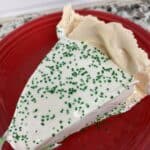
Heavenly Lime Pie (Angel Pie)
Heavenly Lime Pie has a crisp meringue shell instead of a regular crust, filled with a tangy lime custard folded into whipped cream. It came from my Great Grandma Thora's handwritten recipe card, and she made hers with lemons. I switched to limes and added a little green, so now it's my St. Patrick's Day pie.
Servings 8
Equipment
Ingredients
- 4 Eggs Separated
- ¼ teaspoon Cream of Tartar
- 1½ Cup Sugar Divided
- 3 Tablespoons Lime Juice
- 1 Tablespoon Lime Rind Grated
- ⅛ teaspoon Salt
- 1 Cup Heavy Whipping Cream
- 1 Tub Cool Whip
Instructions
- Preheat Oven to 275° F.
- Grease 9" pie pan, set aside.
- Separate egg whites from yolks. Set yolks aside.
- To make meringue crust, beat egg whites until foamy.
- Add cream of tartar and beat until whites peak.
- Continue beating while adding 1 cup of sugar gradually. Keep beating until stiff.
- Spread the meringue into pie pan, hollowing out most of the center. Be careful not to spread too close to the top of the rim.
- Bake at 275° for 1 hour.
- Set aside to cool.
- While meringue is baking, prepare filling.
- Beat egg yolks.
- Stir in ½ cup sugar, lime juice, lime rind, and salt.
- Place in double boiler and cook until thick - about 8-10 minutes. Stir occasionally.
- Remove from heat and cool.
- Whip 1 cup of heavy cream and stir into lime mixture. Use this to fill the meringue crust.
- Chill in freezer for 1 hour.
- Spread Cool Whip on top, almost to top of pie shell.
- Refrigerate for 24 hours or freeze for at least 2 hours.
Notes
Helpful Tips
- A stand mixer makes this easy: The meringue crust wasn't as hard as I thought it would be. In my opinion, a stand mixer is the best way to make a meringue. Stiff peaks form pretty quickly, and you can work on other parts of the recipe while it's mixing.
- Start with a clean, dry bowl: Any grease or speck of yolk in the bowl will keep the whites from whipping up. Wipe the bowl and whisk with a little vinegar or lemon juice first if you want to be sure. Glass or metal beats plastic here, since plastic holds onto oils.
- Separate your eggs cold; whip them warm: Cold yolks hold together better so they're less likely to break into the whites. Then let the whites sit out for 20 or 30 minutes before you beat them, because room temperature whites whip higher.
- Add the sugar slowly: Pour it in a little at a time while the mixer is running. Dump it all in at once, and the meringue goes grainy or weeps sugar syrup while it bakes. You'll know it's ready when the meringue is glossy and doesn't feel gritty between your fingers.
- Low and slow is the whole point: 275°F for an hour dries the meringue out rather than browning it. That's what gives you a crisp shell instead of a chewy one. Resist turning the heat up to speed things along.
- Let it cool in the oven: Turn the oven off and leave the door cracked with the crust still inside. Sudden temperature changes cause most cracking. A few cracks are fine anyway since the filling covers them.
- Pick a dry day if you can: Meringue pulls moisture out of the air, so a humid or rainy day can leave you with a sticky, soft crust no matter what you do. This is the one thing you can't really fix with technique.
- Don't rush the chill: The 24 hours in the fridge isn't me being picky. The filling needs that time to firm up enough to slice, and the meringue softens into something almost marshmallowy underneath, which is the best part.
- Green is optional: I added green dye to the filling and green sprinkles to the top to make it extra festive. You can leave it plain if you like.